
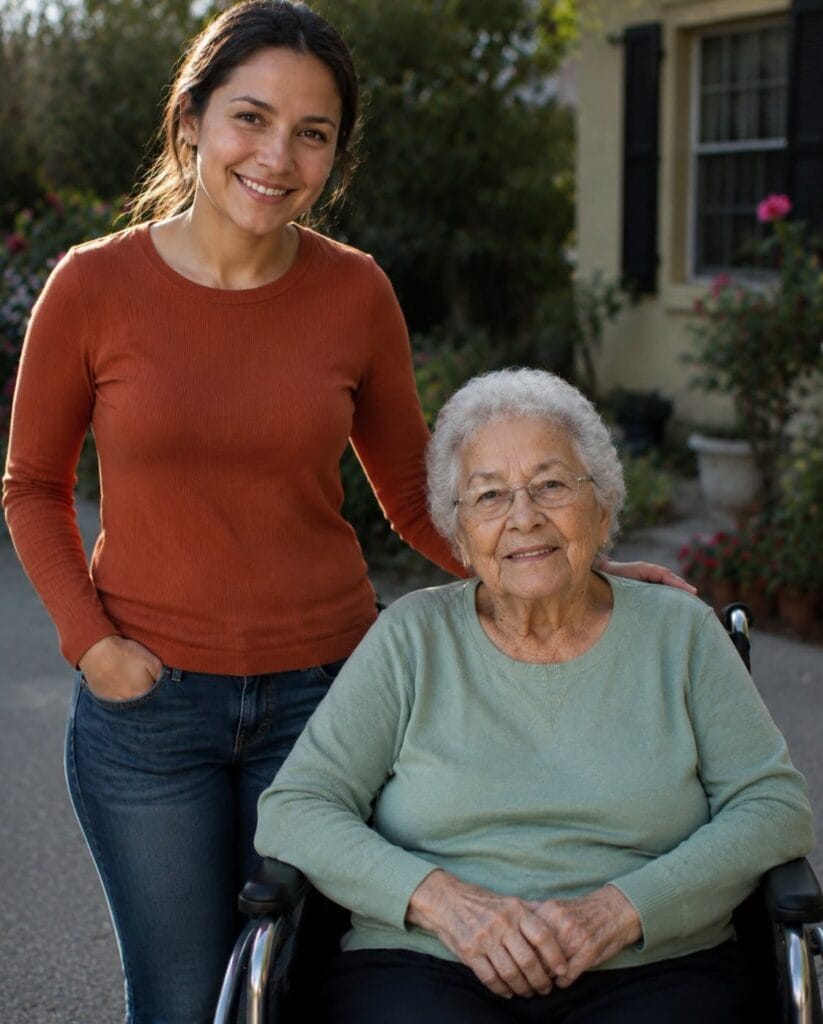
My wealthy grandmother promised I’d inherit everything she owned. For three years, I fed her, bathed her, and stayed by her side.
Then she died and left me absolutely nothing. The next morning, her lawyer handed me a garage key, and what I found inside brought me to my knees.
The apartment was quiet that Tuesday evening, the kind of quiet that made the refrigerator hum sound louder than it should. I sat at my small kitchen table, stacks of overdue bills spread out like a deck of cards I could not win with.
On the shelf above the stove, a faded photograph of my parents watched over me, the same way it had every night since I was seven. My name is Emily, and I had been tired for as long as I could remember.
A faded photograph of my parents watched over me. After my parents died, my grandmother, Margaret, took me in.
She owned a chain of grocery stores across three counties. We had money, but I never saw a dollar of it.
I still remembered the day I told her I had been accepted to college. “That’s nice, Emily,” she said, not looking up from her newspaper.
“I was hoping… maybe you could help with tuition?” “I’m not your mom.
I’m not your dad. Don’t expect me to act like I am.” So I worked two jobs and signed for loans I was still paying off six years later.
We had money, but I never saw a dollar of it. I rubbed my eyes and looked at the photograph of my parents again.
“I’m trying, Mom,” I whispered. “I really am.” My phone buzzed against the table.
The screen showed Grandma’s house. I almost did not pick up.
“Hello?” “Emily, it’s Linda.” Linda had been my grandmother’s housekeeper since before I was born. She always answered the phone first, always with that careful, measured tone.
My phone buzzed against the table. “Your grandmother wants to speak with you,” Linda continued.
“Hold on.” There was a long shuffle, the sound of a chair creaking, then a thinner voice than I remembered. “Emily.” “Grandma.
Are you okay?” “No. I’m not.” I gripped the phone tighter.
She did not waste words. She never had.
“The doctors say I don’t have long,” Grandma continued. “A year, maybe two.” “Your grandmother wants to speak with you.” I did not know what to say.
We had not spoken in eight months. Before that, it had been birthday cards with a single line of writing inside.
“I’m sorry,” I finally managed. “Don’t be sorry.
Be useful. I need someone to take care of me,” she said.
“Linda can’t do it alone. I want you to come home.” “Grandma, I have work, I have, ” “Emily.” Her voice cut through mine.
“If you come, everything I have goes to you. The house.
The stores. All of it.
Every penny.” “Don’t be sorry. Be useful.
I need someone to take care of me.” I stared at the bills on my table. A few short years of caring for a woman who had never once told me she loved me, in exchange for a life free from drowning.
“Why now?” I asked quietly. “Why me?” There was a pause on the line.
A long one. “Because you’re the only one left,” she said.
Then the line went silent, and I sat there in the dim kitchen, wondering if what I had just agreed to was love, or just the last transaction we would ever make. “Because you’re the only one left.” The drive back to Grandma’s old house felt heavier than I expected, her frail voice from that phone call still echoing in my ears like a debt I had agreed to pay.
I unpacked my single suitcase in the guest room and told myself this was love, not a transaction. The first morning, Linda was already in the kitchen, pouring tea into Grandma Margaret’s favorite cup.
“She doesn’t like sugar anymore,” Linda told me without looking up. “And she’ll ask you three times if the door is locked.
Just answer her each time.” I told myself this was love, not a transaction. “Thank you,” I said quietly.
Linda finally glanced at me. “You’ll see.
She’s not the woman you remember.” *** The years blurred into routines. Doctor visits on Tuesdays.
Walks in the garden when her legs allowed it. Buttoning her blouse when her fingers trembled.
I read to her in the evenings while she stared at the window. “Your hair is too long,” Grandma said once, not turning her head.
“And that dress. Where did you find that dress, Emily?” The years blurred into routines.
“It was on sale, Grandma.” “Hmm.” That was the closest we came to conversation most nights. I noticed the letters.
Grandma wrote them by hand at the small desk in her bedroom, then slid them into a locked drawer the moment I knocked. She took private phone calls too, lowering her voice the second I crossed the hallway.
That was the closest we came to conversation most nights. One evening I paused outside her door, a tray of soup in my hands.
“She must never know,” Grandma was saying. “Not yet.
Promise me.” I stepped back, my pulse loud in my ears. When I brought the tray in, she smiled the smallest smile I had ever seen on her face.
“Sit with me,” she said. I sat.
She did not speak again for an hour. “She must never know.” At night I lay awake asking myself the same question over and over.
Was I here because I loved her, or because she had promised me everything? The answer kept changing depending on the hour.
Some days, when she gripped my hand during a coughing fit, I knew I would have stayed without the promise. Other days, when she criticized the way I sliced bread or dressed, I felt my own bitterness rise.
The answer kept changing depending on the hour. “You waste too much,” she snapped one afternoon.
“You never learned the value of money.” “I worked two jobs through college, Grandma. I think I learned.” She looked at me for a long moment.
“We’ll see,” she said, and turned away. On a quiet Sunday in October, Grandma passed away in her sleep.
Linda found her first. I came running down the hall in my robe and froze at the doorway.
Grandma passed away in her sleep. The funeral passed like a dream I could not wake from.
A week later, I sat in her lawyer, Mr. Bennett’s, office, my hands folded tight in my lap.
He cleared his throat and opened the folder. “The estate of Margaret,” he began, “is to be donated in full to charity.” I blinked.
“The savings, in the amount listed here, are bequeathed to Linda, in gratitude for her decades of service.” The funeral passed like a dream I could not wake from. My mouth went dry.

“The jewelry will be divided among the named friends and acquaintances.” I waited. He did not look up.
“And to me?” I finally asked. Mr.
Bennett’s eyes lifted slowly. “There is no further bequest in the will.
I’m sorry.” I walked out of his office in silence, the years collapsing behind me like a hallway with no doors, wondering what on earth I had given my life to. “There is no further bequest in the will.
I’m sorry.” I drove back home in silence, the lawyer’s words still echoing in my ears. Years of my life, and nothing to show for it.
I sat on the edge of my bed and stared at the wall until the light outside faded. Every cold dinner, every criticism, every silent breakfast played back like a film I could not stop.
My phone buzzed. Linda’s name lit up the screen.
I almost did not answer. Then I did.
Years of my life, and nothing to show for it. “Emily, dear,” she said softly.
“I just wanted to say how sorry I am. Your grandmother, she always knew what she was doing, you know.” Something snapped inside me.
“She knew what she was doing?” I said. “Is that supposed to comfort me, Linda?” “That is not what I meant.” “I bathed her.
I drove her to every appointment. And you walk away with her savings?” She was quiet for a long moment.
“You do not understand everything yet, Emily.” Something snapped inside me. “Then explain it to me.” “I cannot.
Not over the phone.” I laughed bitterly. “Of course you cannot.
You whispered with her for years behind closed doors. I am not stupid.
I saw what was happening.” “Emily, please.” “Did you talk her out of it? Did you convince her I did not deserve anything?” “I would never.” “Then why are you the one with her money?” “I am not stupid.
I saw what was happening.” The line went silent. Then a small breath.
“Because she asked me to keep a promise. That is all I can say.” I hung up.
My hands were shaking so hard that the phone slipped onto the blanket. I thought about contesting the will.
I thought about calling every lawyer in the city. Then I remembered I could barely afford rent.
I cried until I fell asleep with my clothes still on. “Because she asked me to keep a promise.
That is all I can say.” The next morning, a steady knock at my door pulled me upright. I opened it to find Mr.
Bennett standing on the small landing, an envelope in his hand. “Miss,” he said gently.
“Your grandmother left specific instructions that I deliver this to you on this exact date. Not a day earlier.” “More instructions,” I muttered.
“Of course.” He held it out. “I think you should open it alone.” I took it without thanking him.
I closed the door before he could say more. The envelope was thick.
I tore it open at the kitchen counter, my fingers clumsy. “Your grandmother left specific instructions that I deliver this to you on this exact date.” A small brass key fell out first.
Then a folded note in her handwriting, the same slanted script that used to sign my birthday cards with nothing but her name. I read it twice.
You will find a garage at this address. Inside is what you truly deserve.
I sat down on the floor. What I truly deserved… After everything, was this her final word?
A storage unit that was probably full of old junk? A last quiet humiliation from the woman who never once told me she was proud of me?
I grabbed my keys. A small brass key fell out first.
The drive across town took thirty minutes. I do not remember any of it.
I remember pulling up to a row of rented garages on a quiet industrial road, the numbers matching the address on the note. I stood in front of the door for a long time before I bent down and slid the key into the lock.
The metal door rolled up with a slow groan. The first thing that hit me was an overwhelmingly strong smell.
I stepped inside, holding my nose. My knees buckled before my brain could catch up.
I dropped onto the concrete and screamed. “Oh my God.
What is this?” The first thing that hit me was an overwhelmingly strong smell. Hundreds of framed photographs covered every wall.
Me as a baby in my mother’s arms. My first day of school.
My high school graduation, taken from somewhere in the back row. The smell came from fresh paint covering the walls.
On a long table sat blueprints of every grocery store, ownership documents, and a foundation charter. “She never sold the chain, Emily.” I turned.
Mr. Bennett stood in the doorway, holding his briefcase against his chest.
Hundreds of framed photographs covered every wall. “It was reorganized into a foundation,” he continued.
“You are the sole controlling beneficiary. The charity named in the will is this foundation.” I couldn’t speak.
My hands trembled over the papers. He pointed to a sealed envelope resting beside the charter.
“She asked me to let you read this alone.” I waited until his footsteps faded. Then I broke the seal.
He pointed to a sealed envelope resting beside the charter. My Emily, I lost your mother.
I could not survive losing you too, so I held you at a distance and prayed it would make you strong. I pressed my palm to my mouth.
I watched over you all your life, and Linda helped me. She kept my secret because she loved me, and because she loved you.
The next line cracked me open. I wasn’t good at saying I loved you.
So I built something that would keep taking care of you long after I was gone. I watched over you all your life.
I sat on the cold floor and cried until the light outside dimmed. *** Weeks later, I stood in the office of the first store.
Her framed photograph hung above the desk. I touched the glass.
“I love you too, Grandma. I always did.” Then I turned away.
I had a lot to learn about running a business if I wanted to preserve my family legacy. I sat on the cold floor and cried until the light outside dimmed.