
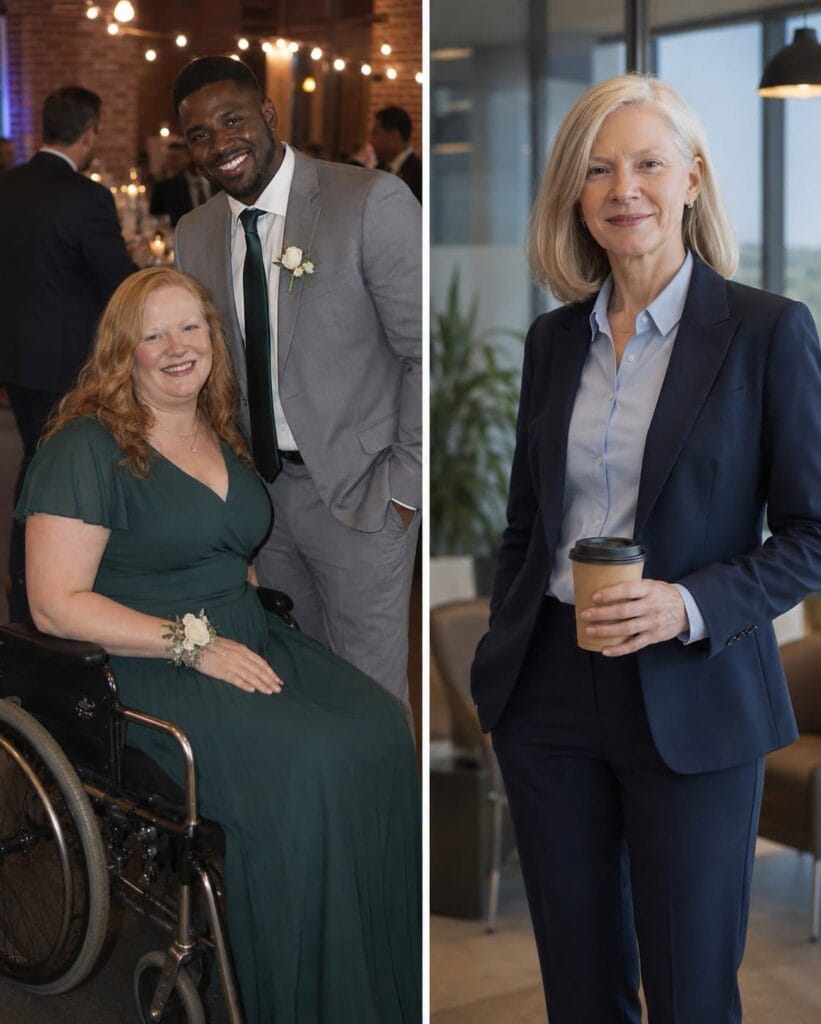
Six months after a crash left me in a wheelchair, I went to prom expecting to be pitied, ignored, and forgotten in a corner. Then one person crossed the room, changed the entire night, and gave me a memory I carried for 30 years.
I never thought I’d see Marcus again. When I was 17, a drunk driver ran a red light and changed everything.
Six months before prom, I went from arguing about curfew and trying on dresses with my friends to waking up in a hospital bed with doctors talking around me like I wasn’t in it. My legs were broken in three places.
My spine was damaged. There were words like rehab and prognosis and maybe.
By the time prom came, I told my mom I wasn’t going. Before the crash, my life had been ordinary in the best way.
I worried about grades. I worried about boys.
I worried about prom pictures. Afterward, I worried about being looked at.
By the time prom came, I told my mom I wasn’t going. She stood in my doorway holding the dress bag and said, “You deserve one night.” “I deserve not to be stared at.” “Then stare back.” She helped me into my dress.
“I can’t dance.” She came closer. “You can still exist in a room.” That hurt, because she knew exactly what I had been doing since the accident.
Disappearing while still technically present. So I went.
She helped me into my dress. Helped me into my chair.
Helped me into the gym, where I spent the first hour parked near the wall pretending I was fine. Then they drifted back toward the dance floor.
People came over in waves. “You look amazing.” “I’m so glad you came.” “We should take a picture.” Then they drifted back toward the dance floor.
Back to movement. Back to normal life.
Then Marcus walked over. I glanced behind me because I honestly thought he had to mean someone else.
He stopped in front of me and smiled. “Hey.” I glanced behind me because I honestly thought he had to mean someone else.
He noticed and laughed softly. “No, definitely you.” “That’s brave,” I said.
He tilted his head. “You hiding over here?” Then he held out his hand.
“Is it hiding if everyone can see me?” But his face just changed. Softer.
“Fair point,” he said. Then he held out his hand.
“Would you like to dance?” I stared at him. “Marcus, I can’t.” He nodded once.
“Okay,” he said. “Then we’ll figure out what dancing looks like.” I laughed before I meant to.
Before I could protest, he wheeled me onto the dance floor. I went rigid.
“People are staring.” “They were already staring.” “That doesn’t help.” “It helps me,” he said. “Makes me feel less rude.” I laughed before I meant to.
When the song ended, he rolled me back to my table. He took my hands.
He moved with me instead of around me. He spun the chair once, then again, slower the first time and faster the second after he saw I wasn’t scared.
He grinned like we were getting away with something. “For the record,” I said, “this is insane.” “For the record, you’re smiling.” When the song ended, he rolled me back to my table.
I asked, “Why did you do that?” I spent two years in and out of surgeries and rehab. He shrugged, but there was something nervous in it.
“Because nobody else asked.” After graduation season, my family moved away for extended rehab, and whatever chance there was of seeing him again disappeared with it. I spent two years in and out of surgeries and rehab.
I learned how to transfer without falling. I learned how to walk short distances with braces.
Then longer ones without them. I learned how quickly people confuse survival with healing.
College took me longer than everyone else I knew. I also learned how badly most buildings fail the people inside them.
College took me longer than everyone else I knew. I studied design because I was angry, and anger turned out to be useful.
I worked through school. Took drafting jobs nobody wanted.
Fought my way into firms that liked my ideas a lot more than they liked my limp. Years later, I started my own company because I was tired of asking permission to make spaces people could actually use.
By fifty, I had more money than I ever expected, a respected architecture firm, and a reputation for turning public spaces into places that didn’t quietly exclude people. He was wearing faded blue scrubs under a black café apron.
Then, three weeks ago, I walked into a café near one of our job sites and dumped hot coffee all over myself. The lid popped off.
Coffee hit my hand, the counter, the floor. I hissed, “Great.” A man at the bus tray station looked over, grabbed a mop, and limped toward me.
He was wearing faded blue scrubs under a black café apron. Later, I learned he came straight from his morning shift at an outpatient clinic to work the lunch rush there.
That was when I really looked at him. “Hey,” he said.
“Don’t move. I’ve got it.” He cleaned the spill.
Grabbed napkins. Told the cashier, “Another coffee for her.” “I can pay for it,” I said.
He waved that off and reached into his apron pocket anyway, counting coins before the cashier told him it was already covered. That was when I really looked at him.
Older, of course. Tired.
Broader through the shoulders. A limp in the left leg.
I went back the next afternoon. But the eyes were the same.
He glanced up at me and paused for half a beat. “Sorry,” he said.
“You look familiar.” “Do I?” He frowned, studying my face, then shook his head. “Maybe not.
Long day.” I went back the next afternoon. He sat down across from me without asking.
He was wiping tables near the windows. When he got to mine, I said, “Thirty years ago, you asked a girl in a wheelchair to dance at prom.” His hand stopped on the table.
Slowly, he looked up. I saw it land in pieces.
The eyes first. Then my voice.
Then the memory. He sat down across from me without asking.
“Emily?” he said, like the name hurt coming out. I learned what happened after prom.
“Oh my God,” he said. “I knew it.
I knew there was something.” “You recognized me a little?” “A little,” he said. “Enough to make me crazy all night after I got home.” I learned what happened after prom.

His mother got sick that summer. His father was gone.
Football stopped mattering. Scholarships stopped mattering.
Survival took over. “I kept thinking it was temporary,” he said.
“A few months. Maybe a year.” He said it with a laugh, but it wasn’t funny.
“And then?” “And then I looked up, and I was 50.” He said it with a laugh, but it wasn’t funny. He had worked every kind of job.
Warehouse. Delivery.
Orderlies’ work. Maintenance.
Café shifts. Whatever kept rent paid and his mother cared for.
Along the way he wrecked his knee, then kept working on it until the injury became permanent. “And your mom?” I asked.
He told me more in pieces. “Still alive.
Still bossy.” “She’s not doing great, though.” Over the next week, I kept coming back. Not pushing.
Just talking. He told me more in pieces.
About bills. About sleeping badly.
About his mother needing more care than he could manage alone. About pain he’d ignored so long he had stopped imagining relief.
So I changed approach. When I finally said, “Let me help,” he shut down exactly the way I expected.
“No.” “It doesn’t have to be charity.” He gave me a look. “That’s always what people with money say right before charity.” So I changed approach.
My firm was already building an adaptive recreation center and hiring community consultants. We needed someone who understood athletics, injury, pride, and what it felt like when your body stopped obeying you.
Someone real. Not polished.
I asked him to sit in on one planning meeting. That was Marcus.
I asked him to sit in on one planning meeting. Paid.
No strings. He tried to refuse, then asked what exactly I thought he could offer.
I told him, “You’re the first person in thirty years who looked at me in a hard moment and treated me like a person, not a problem. That’s useful.” He still didn’t say yes.
He came to one meeting. Then another.
What changed him was his mother. She invited me over after I sent groceries he pretended not to need.
Tiny apartment. Clean.
Worn down. She looked sick, sharp-eyed, and entirely unimpressed by me.
“He’s proud,” she said, once he was out of the room. “Proud men will die calling it independence.” “I noticed.” She squeezed my hand.
“If you have real work for him, not pity, don’t back off just because he growls.” After that, nobody questioned why he was there. So I didn’t.
He came to one meeting. Then another.
One of my senior designers asked, “What are we missing?” Marcus looked at the plan and said, “You’re making everything technically accessible. That’s not the same as welcoming.
Nobody wants to enter a gym through the side door by the dumpsters just because that’s where the ramp fits.” Silence. In the parking lot after, Marcus sat on the curb and stared at nothing.
Then my project lead said, “He’s right.” After that, nobody questioned why he was there. The medical help took longer.
I did not bulldoze him into that. I sent him the name of a specialist.
He ignored it for six days. Then his knee buckled on shift and he finally let me drive him.
The doctor said the damage couldn’t be erased, but some of it could be treated. Pain reduced.
Mobility improved. In the parking lot after, Marcus sat on the curb and stared at nothing.
That was the real turning point. “I thought this was just my life now,” he said.
I sat beside him. “It was your life.
It doesn’t have to be the rest of it.” He looked at me for a long time. Then he said, very quietly, “I don’t know how to let people do things for me.” “I know,” I said.
“Neither did I.” That was the real turning point. Soon he was helping train coaches at our new center.
The next months were not magical. He was suspicious.
Then grateful. Then embarrassed for being grateful.
Physical therapy made him sore and mean for a while. His consulting work turned into regular work, but he had to learn how to be in rooms full of professionals without assuming he was the least educated person there.
Soon he was helping train coaches at our new center. Then mentoring injured teens.
Then speaking at events when nobody else could say things as plainly as he could. One kid told him, “If I can’t play anymore, I don’t know who I am.” He saw it on my desk.
Marcus answered, “Then start with who you are when nobody’s clapping.” One night, months into all of this, I was at home digging through an old keepsake box after my mother asked for prom pictures for a family album. I found the photo of Marcus and me on the dance floor and brought it to the office without thinking.
He saw it on my desk. “You kept that?” “Of course I did.” He looked at me like that was the dumbest thing he’d ever heard.
He picked it up carefully. Then he said, “I tried to find you after high school.” I stared at him.
“What?” “You were gone. Someone said your family moved for treatment.
After that my mom got sick and everything got small fast, but I tried.” “I thought you forgot me,” I said. He looked at me like that was the dumbest thing he’d ever heard.
His mother has proper care now. “Emily, you were the only girl I wanted to find.” Thirty years of bad timing and unfinished feeling, and that was the sentence that finally broke me open.
We’re together now. Slowly.
Like adults with scars. Like people who know life can turn on you and don’t waste much time pretending otherwise.
His mother has proper care now. He runs training programs at the center we built and consults on every new adaptive project we take on.
He is good at it because he never talks down to anybody. “Would you like to dance?” Last month, at the opening of our community center, there was music in the main hall.
Marcus came over, held out his hand. “Would you like to dance?” I took it.
“We already know how.”