
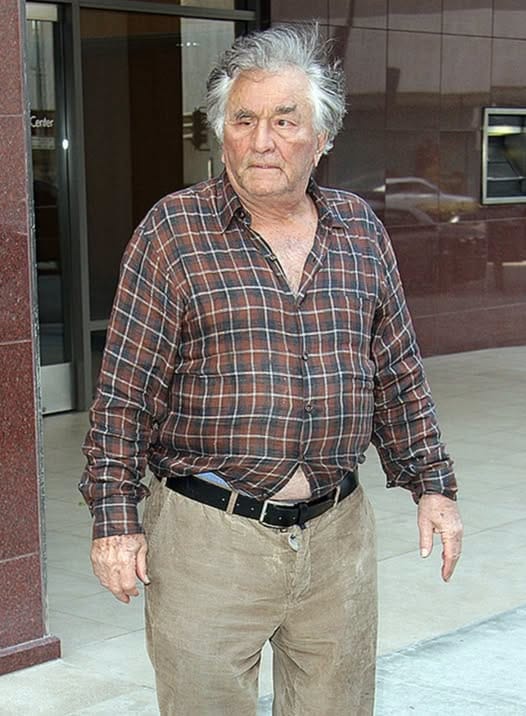
In the reflective light of a 2026 retrospective, Peter Falk remains a deeply compelling figure — not as a living Hollywood presence, but as an enduring symbol of craft, originality, and emotional intelligence. Looking back on his life today means seeing more than the famous trench coat and the unforgettable “one more thing” rhythm of Lieutenant Columbo. It means recognizing an actor whose work reshaped television mystery and whose later years revealed the difficult human cost that can follow even the most celebrated careers.
Peter Falk, born September 16, 1927, in New York, became best known for playing the eccentric Los Angeles detective Lieutenant Columbo in Columbo. Britannica notes that he portrayed the character across decades, from the late 1960s through 2003, winning four Emmy Awards for the role. He died on June 23, 2011, in Beverly Hills, California, at age 83. (Encyclopedia Britannica)
The foundation of Falk’s legacy was built on theatrical excellence and a rare understanding of character. As the rumpled, deceptively absent-minded Columbo, he did not simply solve crimes. He changed the structure of television mysteries. Instead of relying on a glamorous detective image, Falk created a character who seemed ordinary, disarming, and almost forgetful — until his quiet intelligence revealed the truth.
That was the genius of his performance. Columbo was not powerful because he looked powerful. He was powerful because he listened, watched, waited, and asked the question no one else thought to ask. Falk’s work gave the detective genre a new emotional texture, proving that the most memorable characters are often those built from patience, curiosity, and heart.

Source: Britannica
Before and beyond Columbo, Falk built a career that stretched across stage, film, and television. Britannica lists his early major film roles in Murder, Inc. and Pocketful of Miracles, both of which earned him Academy Award nominations for Best Supporting Actor. He also appeared in notable films such as It’s a Mad, Mad, Mad, Mad World, The Great Race, A Woman Under the Influence, The Princess Bride, and Wings of Desire. (Encyclopedia Britannica)
His greatness came from the fact that he never seemed manufactured. Whether he was playing a detective, a comic presence, or a dramatic supporting figure, Falk carried a grounded human quality. He understood how to make imperfection magnetic. His characters often felt lived-in, textured, and real — the opposite of polished Hollywood distance.

Source: Wikimedia Commons

The later chapter of Falk’s life required a different kind of strength, one shaped not by performance but by care, family conflict, and legal protection. In 2009, a Los Angeles court placed Falk under conservatorship after medical testimony described advanced dementia, likely connected to Alzheimer’s disease. His daughter Catherine Falk had petitioned the court over concerns about access to her father, while his wife, Shera Falk, remained in charge of his personal care and affairs. (ABC7 New York)
This part of the story adds a sobering dimension to his legacy. The man who spent decades portraying a detective devoted to truth and detail eventually became the center of a painful family and court struggle over protection, visitation, and dignity. Catherine’s efforts reflected a daughter’s concern for her father’s well-being, even as the court ultimately allowed Shera Falk to continue overseeing his care.
By viewing Falk’s story from 2026, the focus becomes not only his fame, but the fragility that can exist behind it. His final years remind us that even beloved public figures can face private vulnerability. The applause fades, the roles become history, and what remains is the human need for safety, compassion, and respectful care.
This does not diminish Falk’s legacy. If anything, it makes it more complete. He was not only an actor who created one of television’s greatest characters. He was also a man whose life, like any life, included brilliance, complexity, aging, illness, family tension, and the need to be protected when he could no longer fully protect himself.
In 2026, Peter Falk stands in memory as a beacon of substance and artistic courage. His performances continue to influence actors, writers, and audiences who value intelligence over spectacle and humanity over perfection. His Columbo remains timeless because the character was never about flash; he was about persistence, humility, and the quiet pursuit of truth.
Peter Falk did not merely inhabit iconic roles. He built a body of work rooted in curiosity, grit, humor, and emotional honesty. His legacy endures because he made the small details unforgettable — a pause, a glance, a question, a crumpled coat, a mind always working beneath the surface.
And perhaps that is why his memory still feels so alive. The greatest mystery he left behind is not one Columbo could solve on screen. It is the mystery of how one actor could turn simplicity into brilliance and leave behind a character — and a career — that remain impossible to ignore.