
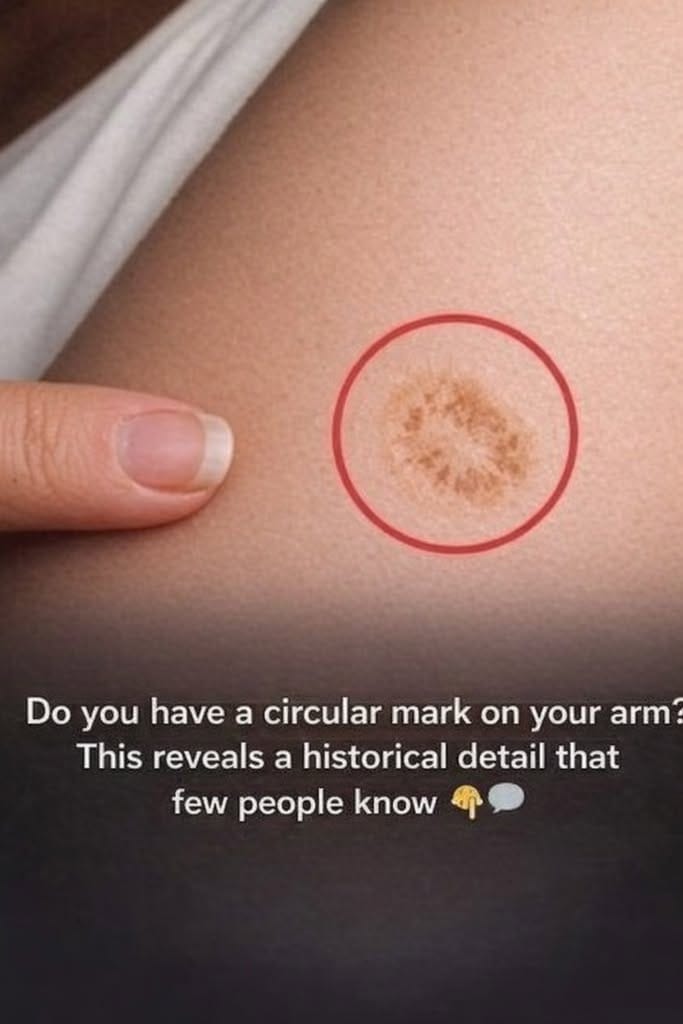
Take a look at your upper arm, usually near the shoulder. Do you have a small, circular, slightly indented scar? It might look like a pale crater or a textured “sunburst” in your skin.
If you grew up in certain parts of the world, or were born before a specific year, this mark is as common as a freckle. As a new generation reaches adulthood without it, this scar has become a rare “historical fingerprint.” It isn’t just a mark from a childhood needle; it is a permanent badge of one of humanity’s greatest victories. This is the Smallpox Vaccine Scar.
While most people know it’s “just a vaccine mark,” there are “insider” history that explain why it looks the way it does, why it’s only in that specific spot, and why it is arguably the most successful “tattoo” in human history.
1. The Anatomy of the Scar: It’s Not a Regular Needle
The most common question people ask is: “Why did this one vaccine leave a scar when my flu shot didn’t?”
The answer lies in a specialized tool that has almost disappeared from modern medicine: the Bifurcated Needle.
=
The “Two-Pronged” Secret: Unlike a standard syringe that injects liquid deep into the muscle, the bifurcated needle is a tiny, two-pronged fork.
The Technique: Doctors didn’t “inject” the smallpox vaccine. They dipped the fork into the vaccine solution and then stabbed the skin 15 times in rapid succession. This created a localized infection on the surface of the skin.
The “Take”: The scar isn’t from the needle itself; it’s from the scab that formed afterward. If you didn’t get a “pock” (a blister) that eventually scarred, the vaccine didn’t “take,” and you weren’t immune.
2. The Truth: A Literal Biological Time Machine
If you have this scar, you are part of a specific “cutoff” in human history.
The 1980 Threshold
In 1980, the World Health Organization (WHO) made a historic announcement: Smallpox was officially eradicated. It was the first (and only) human disease to be completely wiped off the face of the earth.
The “Insider” Detail: Because the disease was gone, countries slowly stopped routine vaccinations. If you were born in the U.S. after 1972, or in most other countries after 1980, you likely don’t have this scar.
The “Global Fingerprint”: You can often tell where someone grew up by their scar. In many developing nations, the vaccination programs continued longer, meaning someone from the 1990s might still carry the mark while their Western peers do not.

3. 5 “Under-the-Radar” Facts About the Circular Mark
I. The “Bovine” Connection
The word “vaccine” actually comes from the Latin word vacca, meaning cow. The very first version of this “arm-stabbing” technique used Cowpox—a milder version of the disease found in milkmaids—to protect humans from the deadly smallpox. Every time you look at that scar, you are looking at a 200-year-old link to a farm animal.
II. Why the Left Arm?
Have you noticed almost everyone’s scar is on their left arm? This was an “insider” standardization for the sake of efficiency. Because most people are right-handed, vaccinating the left arm meant less soreness in the dominant hand. It also allowed international health workers to quickly check a person’s “immunity status” just by glancing at one specific spot.
III. The “Smallpox vs. BCG” Confusion
There is a “decoy” scar! Many people have a similar circular scar on their arm from the BCG (Tuberculosis) vaccine.
How to tell the difference: Smallpox scars are typically indented (like a crater), while BCG scars are often raised or flat. If your scar is very high up on the shoulder, it’s more likely to be BCG.
IV. The “Live Virus” Risk
Unlike modern “mRNA” or “inactivated” vaccines, the smallpox vaccine was a “live” virus (Vaccinia). This meant that for two weeks after the jab, the spot on your arm was actually contagious. If you touched the “pock” and then touched your eye, you could spread the infection. The scar is essentially the “burn mark” of a battle your body won.
V. The “Re-Emergence” Anxiety
In recent years, with the global spread of Mpox (formerly Monkeypox), researchers have discovered that people with this “Old School” scar may actually have a lingering “Insider Advantage.” Because Mpox is in the same “Orthopox” family as smallpox, that 40-year-old scar might still be providing a low level of cross-protection today.
4. The “Insider” Cultural Impact: The Mark of a Generation
For Baby Boomers and Gen X, the scar was a “Rite of Passage.” It was a shared experience of “the pock,” the “itch,” and the final “shield” against a disease that killed 300 million people in the 20th century alone.
In some cultures, the scar was even used as a way to “prove” age or identity when birth certificates were missing. If you had the “mark,” you were a member of the protected global society.
5. Why the World “Needs” to Remember the Scar
In an era of vaccine hesitancy, that small circular mark is a physical “Fact-Check.” It is proof that we can win. It is the only scar in human history that represents a Happy Ending.
When you see that mark on an elderly relative or a stranger in line, you aren’t just seeing a medical byproduct. You are seeing a survivor of a war that humanity finally won. It is a badge of collective intelligence and global cooperation.
The circular mark on your arm isn’t a blemish; it’s a Medal of Honor. It reveals that you—or your parents—were part of the final generation to fear a monster that had haunted humanity for 3,000 years. It is a story of cows, bifurcated needles, and a global effort that proved, for one shining moment, that we could all agree on one thing: Life is worth saving. Next time you catch a glimpse of that crater in the mirror, don’t wish it away. Wear it with pride—it’s the coolest historical “insider” detail you’ll ever carry.
Does your “Circle” have a story?
Do you remember getting the pock, or do you have the “BCG” version instead?