
I Loaded My Dead Son’s Pristine Stroller With All His Unused Clothes and Handed Them to a Homeless Mother Sobbing on the Curb—Until I Woke Up to Seventy-Two Brand-New Strollers Blanketing My Entire Lawn, and the Note Inside the Center Box Exposed an Unbelievable Medical Conspiracy Involving My Runaway Husband
The silence inside a house where a newborn was supposed to live doesn’t just feel empty; it echoes like a physical weight against the walls. It was 5:15 AM on a freezing, rain-swept Friday. The rhythmic, agonizing click of the nursery ceiling fan was the only sound cutting through the dark.
My name is Hannah. I am thirty-four years old. Three weeks ago, I checked into the hospital with a heart full of joy, and four days later, I checked out carrying nothing but a white cardboard box containing my son Leo’s hospital footprints and a lock of his soft brown hair.
He never came home. A sudden, untreatable congenital heart defect took him from my arms before he could even open his eyes to see the morning light.
Then came the second abandonment.
=
Just two weeks after the funeral, my husband, Julian, stood in our bedroom, his face cold and hollow as he packed three heavy leather suitcases. He didn’t offer a hug. He didn’t look at my tear-stained face. He simply reached into his pocket, tossed his house keys onto the kitchen counter, and muttered, “I can’t do this, Hannah. I can’t look at that empty nursery, and I can’t look at you anymore. Every time I see your face, I just see what we lost. I’m out.”
He changed his phone number, blocked my social media accounts, and left me entirely alone in a massive house filled with the ghosts of a life that had ended before it even started.
Every single room was a landmine. The brand-new, unblemished white crib. The towering stacks of unopened diapers. The beautiful, tiny forest-green onesies I had spent months meticulously organizing by month and size. I couldn’t breathe inside my own skin.
Two days ago, on my way back from the cemetery, my tires ground to a halt near the edge of the local grocery store parking lot.
Sitting on the freezing concrete curb was a young woman, her face pale, her lips cracked from the biting wind. A tiny newborn baby was tucked securely against her chest in a faded fabric carrier that was dangerously fraying at the shoulder straps. A piece of cardboard propped against her knee read: “Anything helps. Out of options. God bless.”
I sat in my idling car for forty-five minutes, my hands gripping the steering wheel as the hot, heavy tears blurred my vision. I didn’t see a stranger. I saw a mother who had the one thing in the universe I would have given my literal soul to hold—a breathing child—but who had absolutely nothing else to keep him safe.
I drove home like a woman possessed.
I marched straight into Leo’s nursery for the very first time since the hospital. My chest heaving, I packed everything. The top-of-the-line luxury stroller—still gleaming, assembled only once for a tearful practice run down our hallway. The sealed boxes of organic cotton blankets. The musical mobile that played the exact lullaby my own grandmother used to sing to me. Even the plush, soft giraffe blanket I had slept with for weeks so it would smell like me when he arrived.
I crammed it all into my trunk, drove back to the market, and pulled up right beside her curb.
The woman looked up, her guarded, exhausted eyes filled with the immediate, defensive suspicion of someone who has stopped expecting kindness from the world.
“Please,” I choked out, my voice cracking into a raw, bleeding sob as I began piling the beautiful baby gear onto the sidewalk beside her. “I need you to take these. My son… my son never got the chance to use them. Let his things keep your baby warm.”
The woman stared at the pristine, expensive stroller, then down at the giraffe blanket, and suddenly burst into thick, uncontrollable tears, burying her face in her hands.
That night… for the very first time since Leo’s heart stopped beating… I slept for more than two hours. The black, suffocating weight in my lungs felt just a fraction lighter.
But the peace didn’t last past the dawn.
At 5:45 AM, the violent, frantic ringing of my front doorbell shattered the morning quiet.

The Gathering on the Lawn
I threw a heavy wool robe over my shoulders, my heart hammering against my ribs as I ran down the stairs, thinking my husband had finally come home to apologize.
I threw the heavy oak door wide open.
Nobody was standing on the porch. The gravel driveway was completely empty.
But as I stepped out into the freezing morning mist, my jaw dropped, a sharp, breathless gasp escaping my throat.
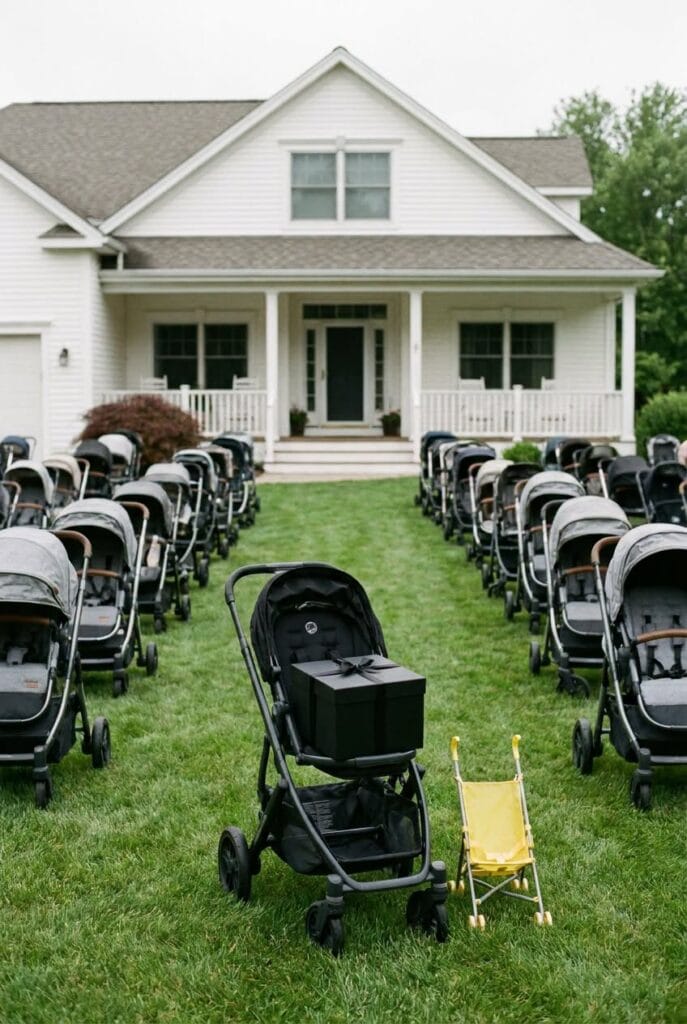
My entire front lawn—from the edge of the white picket fence all the way to the asphalt of the main road—was completely, systematically blanketed in baby strollers.
Seventy-two of them. Brand-new, heavy-duty, modern strollers of every shape and color, arranged in perfect, military-style rows across the wet grass. The early morning frost clung to their hoods, making the entire yard gleam like a field of silver.
And resting inside the seat of every single one of those seventy-two strollers was a large, neatly sealed matte-black box topped with a single, white satin ribbon.
My legs felt like lead as I walked out into the middle of the lawn, my slippers soaking through with the morning dew. I stopped in front of the largest stroller in the center row—a magnificent, midnight-black pram with custom chrome wheels that looked identical to the one I had given away the day before.
With trembling hands, I reached out, untied the white satin ribbon, and lifted the heavy black lid.
The moment my eyes landed on the contents inside, a sharp, agonizing scream tore out of my throat. My knees gave out entirely, and I collapsed onto the wet grass, clutching my chest as the world seemed to spin into absolute chaos.
Resting inside the velvet lining of the box was a thick, blue-sealed medical transport file from the State Neonatal Center, an official birth certificate bearing the name Leo Miller, and a private, high-resolution live video monitor displaying a warm, brightly lit nursery room inside a medical facility just four miles down the road.
On the screen, a healthy, robust, and beautiful three-week-old baby boy with thick brown hair was sleeping peacefully under a familiar, forest-green knit blanket.
Taped to the inside of the box lid was a handwritten letter from the homeless mother I had helped on the curb:
**”Hannah. My name is Maya. I am not homeless, and the baby I held yesterday was a medical training doll. I am the senior compliance investigator for the State Medical Board. For ten days, we have been running a highly classified sting operation against a private, black-market adoption ring operating inside the hospital where you gave birth. Your husband, Julian, didn’t leave you because of his grief. He left because he was paid $150,000 by a corrupt regional director to sign a forged death certificate, allowing them to steal your perfectly healthy son and list him as an anonymous casualty so he could be sold to a wealthy out-of-state family.
We had the evidence against Julian, but we couldn’t locate where the broker had moved the infants. We planted investigators across the town, waiting to see if anyone involved in the hospital staff would show remorse. When you brought your son’s real stroller to the curb yesterday—when you bared your broken heart to a stranger—our surveillance team traced the serial number on that luxury chassis. That specific stroller had a tracking chip installed by the hospital’s private boutique. It led our federal task force straight to the secure warehouse where your son and seventy-one other stolen infants were being held for transport.
Every stroller on your lawn belongs to a mother who was told her baby died this month. But your son is alive, Hannah. The agents are waiting for you at the clinic. Go get your boy.”**
The Snap of the Trap
I didn’t call the police. I didn’t wait to change my clothes.
I flew down the highway in my robe, the tears pouring down my face so fast I could barely see the white lines on the road. When I threw open the doors of the private State Neonatal Center, the lobby was a sea of federal agents, state troopers, and weeping mothers who had just been brought to the lawn.
Standing in the center of the room, his hands secured behind his back in heavy steel handcuffs, was Julian.
His face didn’t look cold or arrogant anymore. It was a mask of pure, cowardly terror. When he saw me march through the doors, his knees buckled, and he dropped to the linoleum floor, crying and begging for mercy.
“Hannah, please!” Julian sobbed, his voice a high-pitched, pathetic squeak. “The real estate debts… the developers were going to ruin me! They told me the baby had a heart murmur anyway, that he wouldn’t live a full life! They offered me the money to just walk away and let them handle the paperwork! I did it for us! I did it to save our future!”
I didn’t scream at him. I didn’t strike his face. I stood over him, my stature straight as granite, looking down at the spineless coward I had shared a bed with for five years with a cold, absolute disgust that silenced his pleas instantly.
“You didn’t leave because of the empty nursery, Julian,” I whispered, my voice a dead, freezing register that echoed off the sterile walls. “You left because you were too small to carry the weight of a real family. Enjoy the silence of your cell.”
Two federal agents hoisted him up by his elbows, dragging him past the intake desk and out into the waiting police cruisers, his designer shoes scraping uselessly against the pavement.
Maya—the woman from the curb—stepped out from the medical bay. She wasn’t wearing the frayed carrier or the stained clothes anymore; she wore a sharp, dark blue federal suit, her eyes bright with a profound, beautiful warmth. She held a small, bundle wrapped in a forest-green blanket against her chest.
She walked over and gently laid the warm, heavy weight of my son into my arms.
The moment his tiny, round cheek rested against my neck—the moment his small fingers reached out instinctively to catch the soft wool of my robe—a raw, beautiful, and healing sob tore out of my throat. His heart was beating against mine, strong, steady, and perfectly true.
Lessons in the Frost
The federal prosecution of the neonatal syndicate was the largest medical scandal in the state’s history, resulting in the permanent closure of the hospital and life sentences without parole for the director and the brokers involved. Julian was sentenced to fourteen years in a federal penitentiary for corporate fraud, child trafficking simulation, and perjury, his name entirely erased from the birth certificate by a state judge’s decree.
The lessons of that freezing November Friday are permanently written into the cedar trees of my property:
True strength is found in the willingness to empty your hands: If I had kept Leo’s nursery locked—if I had hoarded his unused clothes and allowed my grief to turn into a bitter, closed fortress—the serial number on that stroller would have sat in the dark forever. We must be willing to give away what we lose to find the road to what we can save.
A coward will always blame the nursery: The people who walk away from you during a storm—the ones who claim the “grief is too heavy” or the “reminders are too painful”—are often the ones who have already sold your peace to finance their own hidden debts. Trust the partner who stays in the wet mud with you, not the one who flees the house to save his own skin.
The ledger of the innocent always clears in the morning: We spend our nights weeping in the dark, believing that the universe has forgotten the sound of our children’s breathing. But justice doesn’t ride a white horse; it shows up on a wet curb with a piece of cardboard, waiting for you to show the light—proving that the quietest act of mercy can shatter the grandest empire of lies.
The Wide Lawn
It is now Thursday, July 16, 2026. A year has passed since the strollers blanketed my grass.
The seventy-two strollers don’t sit on my lawn anymore. They were distributed to young mothers in need through the Leo Miller Legacy Fund, a free, state-backed regional sanctuary we established using the liquidated assets of the corrupt hospital group.
If you walk past our countryside farmhouse on any given summer afternoon, you won’t hear a suffocating silence or the rhythmic, empty click of a nursery fan.
You’ll find a wide, sun-lit porch where the wild white sage grows thick, the air smelling of pine, fresh rain, and the sweet, warm scent of rosemary chicken roasting in the oven.
One-year-old Leo is crawling across the smooth wooden boards, his cheeks pink and healthy, his bright brown eyes shining with laughter as he reaches his tiny hand out to grab a yellow butterfly.
I sit on the porch swing, a cup of warm chamomile tea in my hand, watching him move through the light.
Maya rides up the gravel lane on her cruiser, her face bright with a quiet, steady peace as she cuts her engine and walks up the steps. She doesn’t say a word. She just reaches out her hand, and as Leo grabs her thumb, she looks across the porch at me and gives my wrist two quiet, gentle squeezes—our new, silent code.
“We are right here,” the first squeeze meant.
“And the road is perfectly clear,” the second answered.