
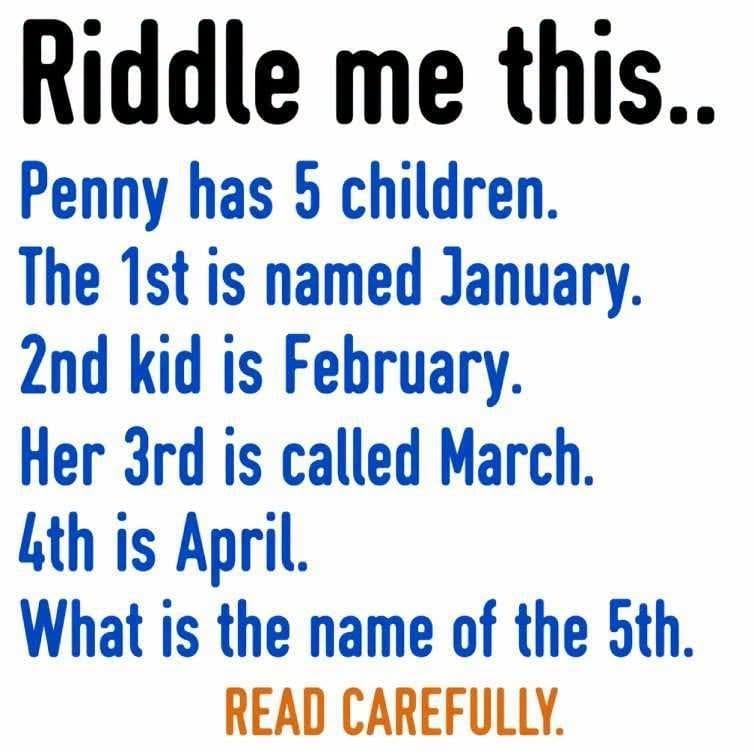
Penny has five children, and the first four are named January, February, March, and April. At first glance, the pattern seems obvious, so many people immediately assume the fifth child must be named May. That answer feels natural because May comes next in the calendar.
However, the riddle tells readers to pay close attention to the wording rather than simply continue the pattern. It asks, “What is the name of the fifth?” but the answer is already hidden in the opening sentence. The trick is designed to make people focus on the months and overlook the most important detail.
The sentence begins with “Penny has five children.” This means Penny is the mother’s name, not the name of the fifth child. Since the fifth child is never directly introduced, the riddle does not actually provide that child’s name anywhere in the text.
Some versions of this puzzle are phrased differently and include wording such as “What is the fifth child’s name?” In those versions, people sometimes argue that the answer is “What.” But in this particular riddle, there is no statement saying the fifth child is named What, and the punctuation does not make that conclusion certain.
The most logical answer is that the fifth child’s name is unknown. May is only an assumption based on the pattern, while the riddle never confirms it. That small missing detail is exactly what makes the puzzle so effective.